Can AI Write Your BOV? Why Chat Tools Give a Different Answer Every Time
General AI chat can draft text, but it can't give you the same numbers twice. Why a BOV needs deterministic math, and how to use AI safely.
By BOVEngine.ai · · 8 min read
More brokers are trying a shortcut. They paste the property brochure, a handful of comps and the rent roll into an AI chat, add a logo, and ask for a Broker Opinion of Value. The first draft often looks impressive, with headings, a value and maybe a table of comps.
Then you ask again, or a teammate does the same thing, and the number changes. A comp disappears. The cap rate math doesn't tie to the NOI. The layout looks nothing like last week's BOV for a different owner.
That's not a small problem. A BOV goes in front of an owner who is deciding which broker to hire, and who may be comparing your number against two or three others. It has to be right, it has to be explainable, and it has to come out the same way every time. This article explains why general-purpose AI chat struggles with that, and how to use AI for the parts it's good at without letting it decide the value.
What a BOV has to get right
A BOV isn't an appraisal (see the three approaches to value in a BOV), but a good one follows the same discipline:
- Correct math. NOI, cap rates, price per SF, price per acre, depreciation and weighting. Every figure has to tie to the figures it came from.
- The same answer from the same inputs. If nothing about the property or the comps changed, the value shouldn't either.
- A recognized method. Owners, investors and their advisors expect the income, sales comparison and cost approaches, reconciled into one conclusion.
- Numbers you can trace. When the owner asks where $165 a foot comes from, you need to point to the comps and the calculation, not a paragraph.
- A consistent, branded format. Every BOV your team sends should look like it came from the same firm.
General AI chat can help with the writing. It has trouble with everything else on that list.
Why chat tools give a different answer every time
1. The same prompt doesn't produce the same output
Language models write by predicting the next word, one piece at a time. Most chat tools add some randomness on purpose so answers don't sound robotic. You might expect that turning the randomness all the way down (a setting called “temperature 0”) would make the output repeatable. Researchers who tested exactly that found it doesn't: with temperature 0 and identical inputs, repeated runs still produced different outputs, and the accuracy of the answers changed from run to run.[1]
A 2025 analysis from an AI research lab traced much of this to how AI services run. Your request is processed together with other people's requests, and the size of that batch changes with server load. That changes the arithmetic inside the model very slightly, which can change the word it picks, and once one word changes, everything after it can change too.[2] From your side of the screen, the same request on Monday and on Tuesday can come back different.
For an email, that's fine. For a valuation, it means two brokers on the same team can paste the same comps and get two different values.
2. The model predicts numbers instead of calculating them
Unless a chat tool hands the arithmetic to a calculator or to code, the model produces the digits that seem most likely to come next. Research on multi-step arithmetic found that accuracy falls sharply as problems get longer: models handle short calculations but fail more and more often as the number of steps grows.[3] Even when a tool does run code, the model still decides which numbers go in and how the steps chain together.
A BOV is a long chain of steps. Rent times square feet, less vacancy and expenses, gives NOI. NOI divided by three cap rates gives a low, mid and high value. Comps get adjusted into a price per SF. Replacement cost less depreciation, plus land, gives a cost value. Then the approaches get weighted and rounded. One slip early in the chain carries all the way to the number on the cover.
3. It fills gaps with confident guesses
When a model doesn't have a fact, it can produce something that sounds right anyway. Researchers call this hallucination: fluent text that isn't supported by the source.[4] In a BOV it can look like a sale date that wasn't on the comp sheet, a price per SF that doesn't match the price and the building size, or a “market cap rate” with nothing behind it. These errors are hard to catch because they read well.
4. Long documents drift
A full BOV runs 20 pages or more: summary, property overview, photos, maps, market overview, sales and lease comps, valuation, pricing, marketing plan, fees, team and disclaimer. Ask a chat tool for all of that and sections get shortened or skipped, tables stop matching the summary, and the formatting changes from one request to the next. You end up checking the whole thing line by line, which is the work you were trying to save.
5. There's no audit trail
When the owner, their attorney or the next broker they interview pushes back on your number, “the AI said so” is not an answer. You need to show the comps you used, the adjustments, the cap rate range and the weighting, and get the same result when you walk through it again.
What “deterministic” means, and why it matters
A deterministic system gives the same output every time it gets the same input. A spreadsheet is deterministic: type the same numbers into the same formulas and you get the same answer, today and next year.
That's the standard a valuation needs. It doesn't mean the value never changes. It means the value changes only when the inputs do, such as a new comp, a different cap rate or an updated rent roll. And when it changes, you can see exactly why.
How BOVEngine.ai splits the work
BOVEngine.ai uses AI where it's strong and fixed code where accuracy matters.
- AI reads your documents. Upload a brochure, rent roll, comp sheets or a market report and AI pulls the property details, tenants, comps and market figures into fields. Extraction can make mistakes too, so every extracted value lands in a field you can see and edit before anything uses it.
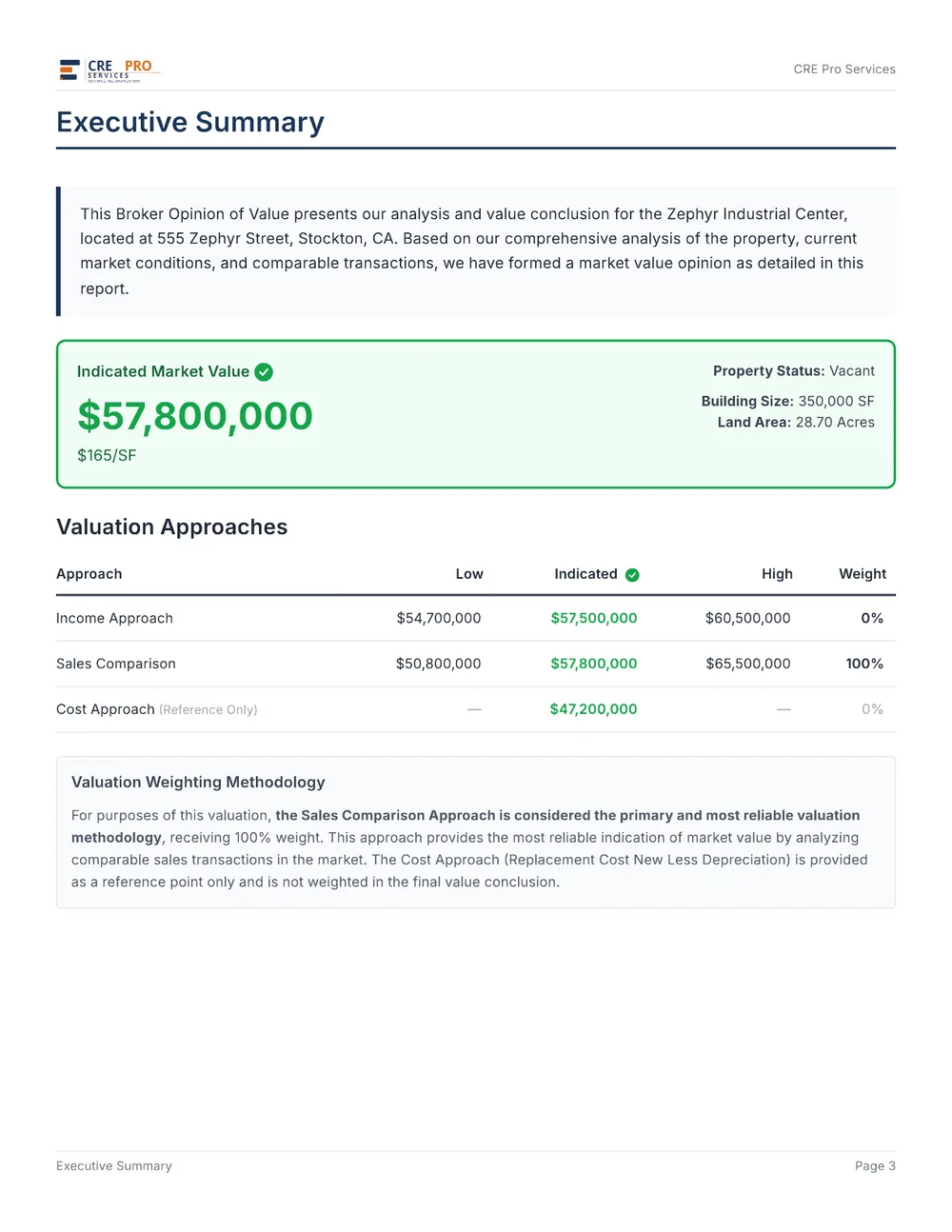
- The math is code, not prediction. One calculator produces every value: the income, sales comparison and cost approaches, the weighting, the low-to-high range and the rounding. The same calculator feeds every screen in the app and every page of the report, so the value on the executive summary always matches the valuation and pricing pages.
- The report is a fixed template. Every BOV comes out with the same sections in the same order, with your logo and colors, whether it's your first report or your hundredth, and whoever on your team built it.
- Same project, same report. Generate the PDF today and again next month without changing anything, and you get the same numbers. Change a comp or a cap rate and you can see exactly which values moved.
- The method follows the appraisal process. The three approaches to value, a weighted reconciliation, and a written disclaimer that the report is a broker opinion, not an appraisal. See what to include in a commercial BOV for the full list of sections.
If you use AI chat for BOV work anyway
Some practical guardrails:
- Use it to summarize documents and draft narrative text, not to compute values.
- Check every number against its source: the comp sheet, the rent roll, the lease.
- Do the math in a spreadsheet or another deterministic tool, and keep the file.
- Save your inputs so you can reproduce the result when someone asks.
- Keep the format the same across your team, so owners don't get a different-looking BOV from each broker.
- Label it clearly as a broker opinion of value, not an appraisal.
The bottom line
AI is good at reading a 40-page offering memorandum in seconds. It is not a valuation method. A BOV that wins listings needs numbers that tie out, a method owners recognize, and a result you can reproduce on demand. That takes deterministic math, with AI doing the reading and drafting around it.
To see the result, look through the sample BOV report: a complete 24-page BOV for a 350,000 SF industrial property, where every figure comes from the same calculator.
Sources
- Atil, B., et al. “Non-Determinism of ‘Deterministic’ LLM Settings.” arXiv:2408.04667, 2024. arxiv.org/abs/2408.04667
- He, H., and Thinking Machines Lab. “Defeating Nondeterminism in LLM Inference.” Thinking Machines Lab, September 2025. thinkingmachines.ai/blog/defeating-nondeterminism-in-llm-inference/
- Dziri, N., et al. “Faith and Fate: Limits of Transformers on Compositionality.” Advances in Neural Information Processing Systems (NeurIPS), 2023. arxiv.org/abs/2305.18654
- Ji, Z., et al. “Survey of Hallucination in Natural Language Generation.” ACM Computing Surveys 55, no. 12 (2023). arxiv.org/abs/2202.03629