What to Include in a Commercial BOV: A Section-by-Section Checklist
A complete commercial BOV checklist: property overview, comps, the three approaches, pricing, marketing plan, fee proposal, team and disclaimer.
By BOVEngine.ai · · 9 min read
A commercial Broker Opinion of Value does two jobs at once. It tells the owner what the property is worth and what to ask for it, and it shows how you'll sell or lease it. Leave out a section and the owner fills the gap with their own assumptions, or with another broker's BOV.
Here is every section a complete BOV should have, in the order owners expect to read them, with what to put in each and why it matters. It follows the same structure as our 24-page sample BOV report.
1. Cover
Your firm's branding, a strong photo of the property, the address, the date and who the BOV is prepared for. The cover is the first sign of how you'll present the property to buyers.
2. Executive summary
One page with the answer: the indicated value, the low-to-high range for each approach, how the approaches were weighted, and the recommended asking price or lease rate. Many owners read this page and the price and nothing else, so it has to stand on its own.
3. Property overview
The facts buyers will ask about: building SF, site size in acres, year built, construction, clear height, loading, power, parking, zoning, and any recent improvements. For land: acreage, zoning, utilities, access and entitlements. Get these right, because every value in the BOV depends on them.
4. Photos, aerials, site and floor plans
Exterior and interior photos, an aerial, and the site plan and floor plans if you have them. They help the owner picture how you'll market the property, and they answer questions before anyone asks.
5. Location maps
A regional map and a local map showing access to highways, ports, rail, labor or retail, whichever drives demand for this property type.
6. Market overview
Vacancy, asking rents, absorption, new construction and recent trends for the submarket, with the source and date of the data. This is the context that explains your cap rates and rents.
7. Comparable sales, leases and land
The evidence behind your value. For each comp, show the address, a photo, the date, the size, the price or rate, and the price per SF (or per acre for land), and mark the comps on a map against the subject. Include:
- Sales comps for the sales comparison approach and to support your cap rates.
- Lease comps for market rent and the asking lease rate.
- Land comps for the land value in the cost approach.
- Available listings to show the competition. Keep them apart from closed deals: an asking price is not a sale.
8. Rent roll
For a leased property, every tenant with suite, size, rent, lease type and expiration. The rent roll drives the income approach, and lease expirations tell buyers how much risk they're taking on.
9. Valuation analysis
The income, sales comparison and cost approaches, each with its inputs and its value, and a reconciliation that explains how you weighted them. Show a low, mid and high value. Our guide to the three approaches to value in a BOV walks through each one with worked examples.
10. Pricing recommendations
The recommended asking price and/or asking lease rate, shown against the indicated value so the owner sees how much room is left to negotiate. If the property will go out unpriced, use this section to set expectations for the offers. See how a BOV wins or loses the listing pitch.
11. Marketing plan
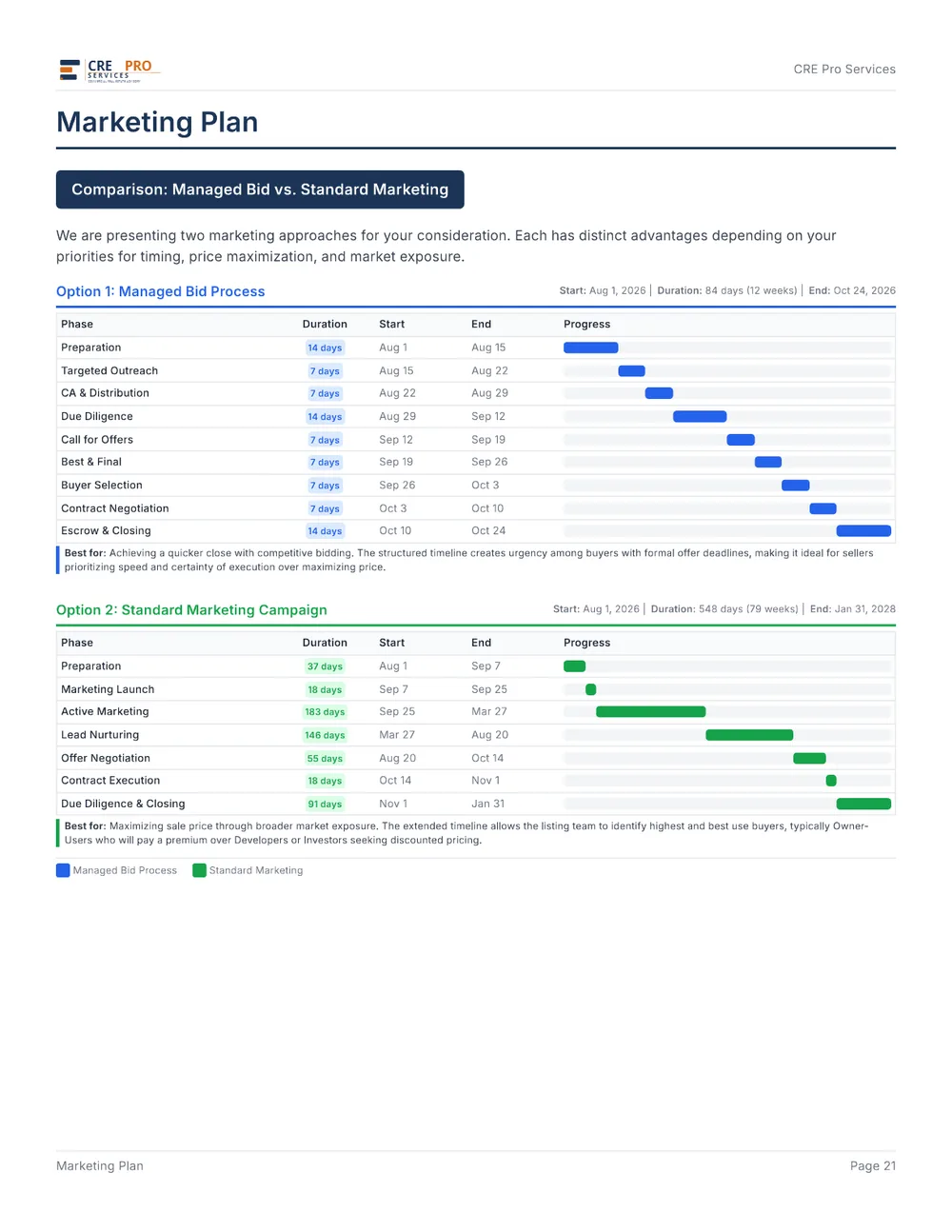
How you'll take the property to market and how long it will take, phase by phase: preparing materials, launch, tours, offers or proposals, negotiation and closing. If you're offering a choice, show the options side by side, such as a managed bid process with an offer deadline next to a longer standard marketing period, and what each one is best for.
12. Brokerage commission
Your fee proposal: the sale commission, the lease commission and how it's structured over the lease term, any cooperating broker split, and when fees are earned and paid. Fees are negotiable, so state them plainly and leave the discussion for the meeting. Owners trust a broker who puts the cost on paper.
13. Your team
Who will work on the assignment, with photos, roles, contact details and relevant experience. The owner is hiring people, and this page tells them who will answer the phone.
14. Disclaimer and limiting conditions
State that the BOV is a broker's opinion of probable price, not an appraisal, and was not prepared under the Uniform Standards of Professional Appraisal Practice (USPAP). Note that projections are estimates and can change. Some states regulate broker price opinions and require specific wording,[1][2] so check your state's rules.
Building all 14 sections without rebuilding them every time
Assembling this by hand means copying comps between spreadsheets, re-checking math, and fixing formatting in a design tool for every pitch. BOVEngine.ai builds all of these sections from your uploads and inputs. AI pulls the data from brochures, rent rolls and comp sheets into fields you review, and one calculator produces every value, so the summary, valuation and pricing pages always agree. Your branding, team members and comps are saved in libraries you reuse on every project, and the PDF comes out the same way every time. (Here's why that consistency matters.)
See all 14 sections in the sample BOV report.
Sources
- Pennsylvania Association of Realtors. “Understanding the new BPO law.” www.parealtors.org/understanding-the-new-bpo-law/
- Minnesota Statutes, section 82.735, Broker price opinions. www.revisor.mn.gov/statutes/cite/82.735