The Three Approaches to Value in a Broker Opinion of Value
How the income, sales comparison and cost approaches work in a commercial BOV, how to weight them, and how a BOV differs from an appraisal.
By BOVEngine.ai · · 9 min read
A Broker Opinion of Value is not an appraisal. But the BOVs that win listings borrow the appraiser's discipline: value the property three ways, then reconcile the results into one conclusion you can defend. Owners, investors, lenders and the owner's advisors all know this framework. When your BOV follows it, your number stops being an opinion pulled from the air and becomes an argument they can check.
This guide walks through each approach with a worked example for a 100,000 SF industrial building on 6.0 acres, shows how to reconcile them, and explains where a BOV and an appraisal part ways.
BOV or appraisal: what's the difference?
| Broker Opinion of Value | Appraisal | |
|---|---|---|
| Prepared by | A real estate broker or agent | A state-licensed or certified appraiser |
| Standard | No national standard; some states regulate broker price opinions | The Uniform Standards of Professional Appraisal Practice (USPAP) |
| Main purpose | Pricing and strategy: whether and how to sell or lease | Lending, litigation, tax, estates, financial reporting |
| Conclusion | A probable sale price or lease rate, plus a recommended asking price | An opinion of market value, as defined for the assignment |
| Turnaround and cost | Usually days, often free as part of a listing pitch | Usually weeks, paid for by the client |
USPAP, published by The Appraisal Foundation, sets the rules for appraisals in the United States.[1] A BOV isn't prepared under it, and it should say so. Rules for broker price opinions vary by state: Pennsylvania, for example, requires specific wording on every broker price opinion and training for the licensees who prepare them,[2] and Minnesota's statute sets out when a licensee may prepare one.[3] Check your own state's rules, and always include a disclaimer.
1. The income approach
The income approach values a property by the income it produces. You estimate the net operating income (NOI) and divide it by a capitalization rate, the return buyers of similar properties accept.
Value = NOI ÷ cap rate. NOI comes from the rent roll if the building is leased, or from market rent if it's vacant or the leases are about to roll. Take the gross rent, subtract an allowance for vacancy and credit loss, then subtract the expenses the landlord pays.
Best for: leased investment properties, where buyers price the income stream. Support your cap rates with recent sales of similar leased properties, not a general market average.
2. The sales comparison approach
The sales comparison approach values a property by what similar properties actually sold for. Pick recent sales that are close in size, age, location, condition and use. Adjust each one for the ways it differs from your property, then settle on a price per SF (or per acre for land).
Best for: owner-user buildings, vacant buildings and land, and any market with enough recent sales. Active listings show your competition, but an asking price is a ceiling, not evidence of value. Keep them separate from closed sales.
3. The cost approach
The cost approach asks what it would cost to build the property today. Estimate the replacement cost of the building, subtract depreciation for age, wear and obsolescence, then add the value of the land.
Best for: newer buildings, special-purpose properties with few comparable sales, and as a check on the other two. A buyer rarely pays much more for an existing building than it would cost to build a new one. Brokers and owners think about land in acres, so show the acreage and the price per acre, not just the land square footage.
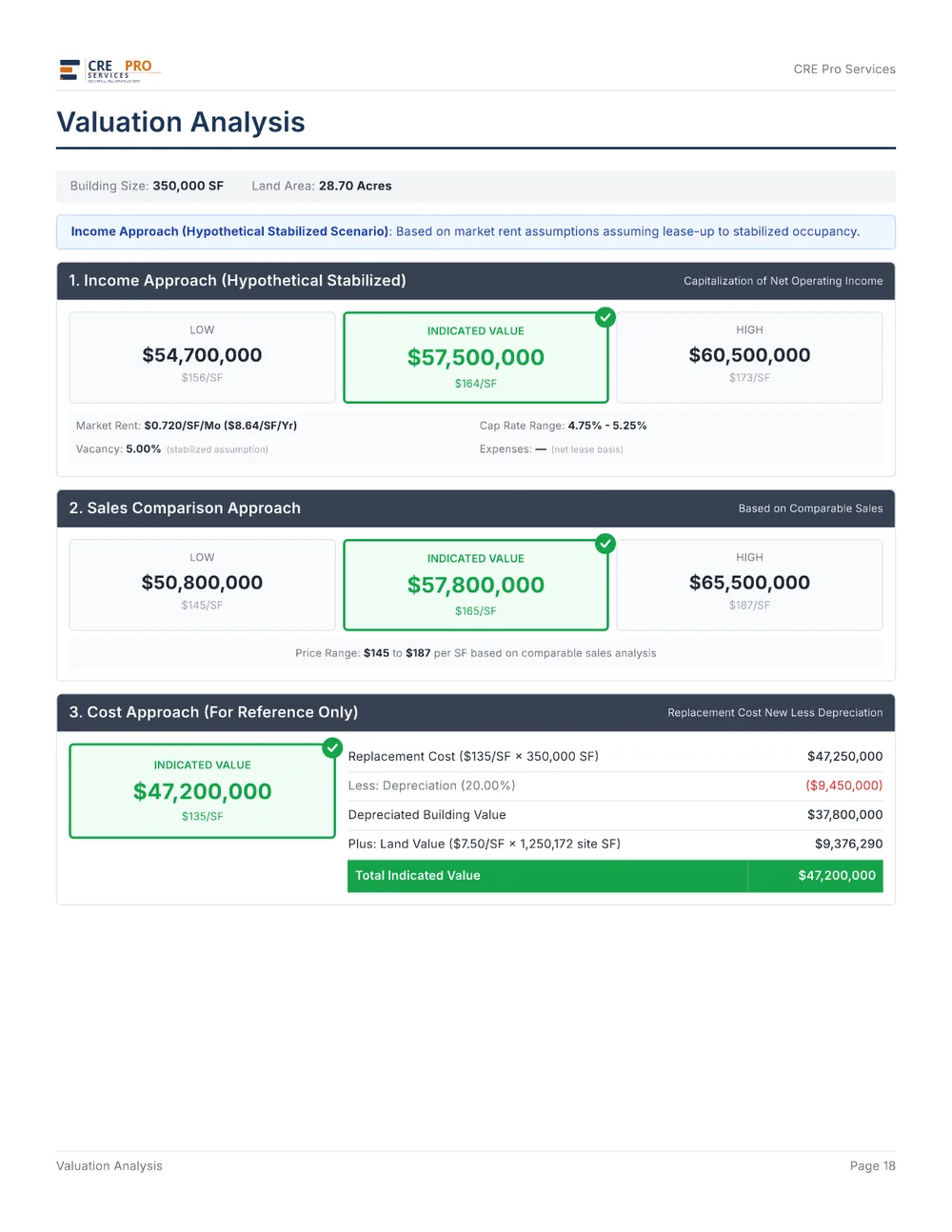
Reconciling the three values
The three approaches rarely agree exactly. Reconciliation is how you get from three numbers to one. It is not a simple average: you weight each approach by how reliable its data is and by how buyers of this kind of property actually make decisions.[4]
A few rules make the reconciliation easier to defend:
- Explain the weights in writing. One or two sentences on why each approach got its share.
- Show a range. A low, mid and high value tells the owner how much the answer depends on the cap rate and the comps you chose.
- Value partly leased buildings in parts. The leased space is worth its income; the vacant space is closer to what an owner-user would pay. Value the leased space with the income approach and add the vacant space at the sales comparison price per SF.
- Drop an approach that doesn't fit, and say why. The cost approach adds little for a 1970s building with heavy depreciation; the income approach doesn't apply to vacant land with no income.
What about land?
Land is usually valued by sales comparison, priced per acre: total acres times a land value per acre drawn from recent land sales. If the land earns income, such as a ground lease or a farming lease, the income approach applies too, and you reconcile the two the same way.
How BOVEngine.ai applies the three approaches
BOVEngine.ai builds each of these approaches from your inputs and comps, then reconciles them with the weighting you choose: income only, sales comparison only, custom weights, or a blended method for partly leased buildings that values the leased space by its income and the vacant space by sales comparison. Land projects get a sales comparison approach priced per acre and an income approach when the land produces income.
One calculator produces every value, with fixed rounding rules, so the numbers on the valuation page match the executive summary and the pricing page every time. The report's reconciliation text is written from those numbers, and a disclaimer page states that the report is a broker opinion, not an appraisal. For why that matters, see why AI chat gives a different BOV every time, or look at the valuation pages in the sample BOV report.
Sources
- The Appraisal Foundation. Uniform Standards of Professional Appraisal Practice (USPAP). www.appraisalfoundation.org/
- Pennsylvania Association of Realtors. “Understanding the new BPO law.” www.parealtors.org/understanding-the-new-bpo-law/
- Minnesota Statutes, section 82.735, Broker price opinions. www.revisor.mn.gov/statutes/cite/82.735
- Appraisal Institute. The Appraisal of Real Estate, 15th edition. Chicago: Appraisal Institute, 2020.