How a BOV Wins (or Loses) the Listing Pitch
Your BOV is the evidence behind your price. How to justify an asking price or lease rate, and set seller expectations even when a deal goes out unpriced.
By BOVEngine.ai · · 8 min read
When an owner is ready to sell or lease, they rarely call just one broker. They interview two or three, and each one leaves a number behind. The owner can't easily judge your marketing reach or your relationships from a meeting. What they can do is lay the BOVs side by side and compare them.
That makes the BOV the most important document in your listing pitch. It's the evidence behind your price, a preview of how you'll handle their property, and the first sample of your work they actually hold in their hands.
The highest number doesn't always win
It's tempting to win the listing with the biggest number. Owners like hearing it, and the broker with the most optimistic price can look like the most confident one. But a price you can't support comes back to you. The property sits, buyers wait for a price cut, and the conversation you avoided in the pitch happens months later, when the owner is frustrated and blames you.
Research on listing prices points the same way. A well-known study of home sales found that getting the initial list price wrong cost sellers both time on the market and money at the sale.[1] Commercial deals have fewer buyers and longer timelines, but the logic holds: a property that starts overpriced goes stale, and buyers notice.
The broker who wins the long game is the one whose number is believable, and whose BOV shows why.
What the owner is really asking
Behind every listing interview are five questions:
- What is my property worth?
- What should we ask for it, and how much room does that leave to negotiate?
- How will you market it, and how long will it take?
- What will it cost me?
- Who will actually do the work?
A strong BOV answers all five in writing, so the owner can reread it after you leave and show it to a partner, an attorney or a family member who wasn't in the room.
Justify the asking price
Your recommended asking price is the number the owner remembers. Build up to it in steps:
- Start with the comps. Show the sales and leases you relied on, with photos, dates, sizes and prices, and mark them on a map against the subject property.
- Value it more than one way. The income, sales comparison and cost approaches each give a value. When they land close together, your number is hard to argue with. (See the three approaches to value in a BOV.)
- Show a range, then your conclusion. A low, mid and high value shows the owner you've thought about what could go right and wrong.
- Separate value from asking price. The indicated value is what you expect the property to sell for. The asking price sits above it to leave room to negotiate. Say how far above, in dollars and as a percentage.
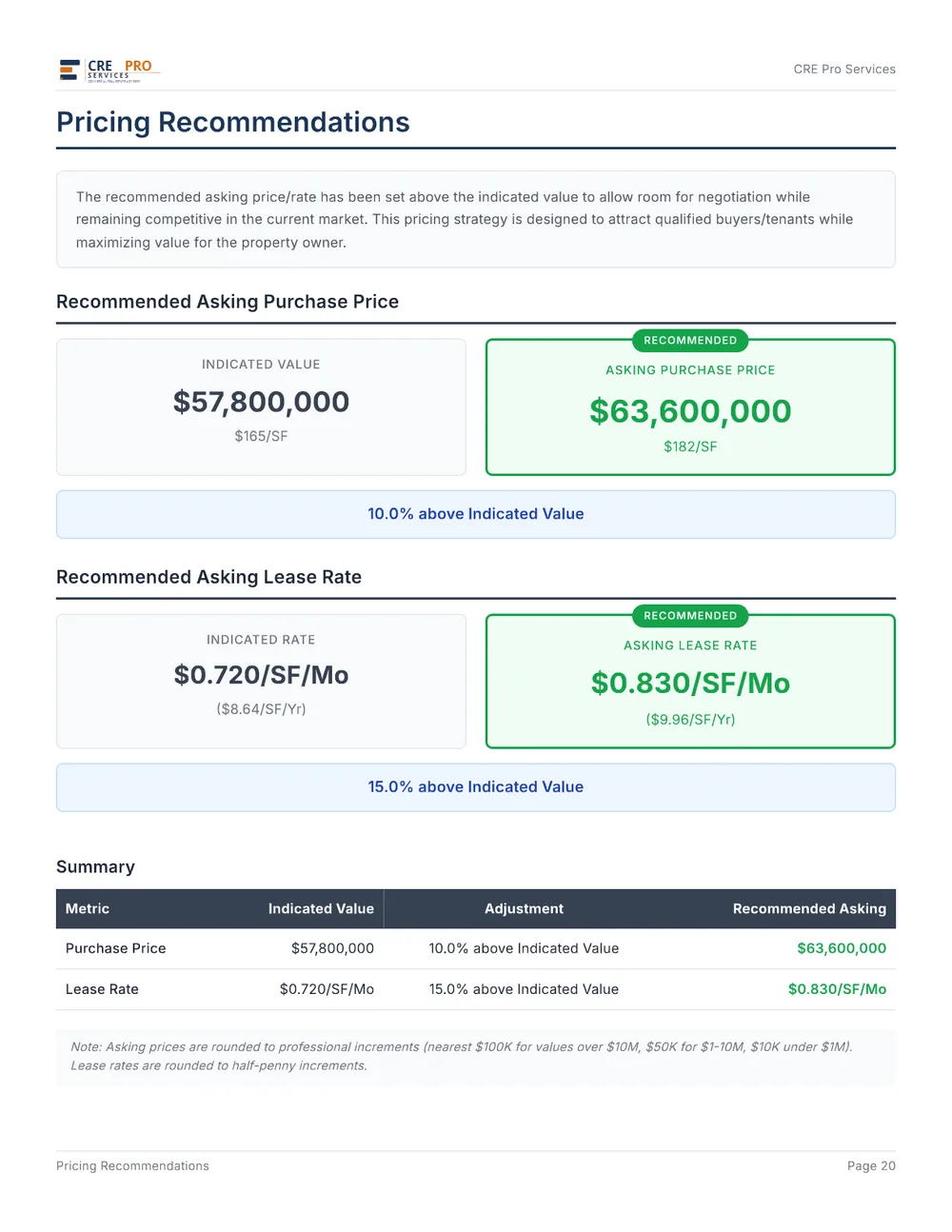
Justify the asking lease rate
For a lease assignment, the same logic applies to the rate. Show recent lease comps for similar space, with size, term, rate and lease type (NNN, modified gross or full service) so the owner compares like with like. Give the recommended asking rate per SF per year and per month, and explain where it sits against the comps. If concessions such as free rent or tenant improvement allowances are common in the market, say so now rather than when the first proposal comes in.
Unpriced doesn't mean no price talk
Many commercial properties go to market without an asking price, through a call for offers or a managed bid process with set deadlines. That can create competition among buyers. But it doesn't remove the need to talk about value with the owner. If anything, it raises it: with no list price, the owner's only reference point is what you told them in the pitch.
For an unpriced offering, use the BOV to set expectations:
- Give the value range anyway. The owner should know what a strong offer, a fair offer and a weak offer look like before any arrive.
- Walk through the timeline. Marketing launch, tours, the offer deadline, a best-and-final round and buyer selection. Owners who know the steps are less anxious in the middle of them.
- Agree on how offers will be judged. Price matters, but so do deposit size, due diligence length, financing and closing timeline.
- Compare strategies. A managed bid tends to suit owners who want speed and certainty; a longer, standard marketing period can reach more buyers, including owner-users who may pay more. Showing both side by side lets the owner choose with you.
Sell the team and the process, not only the price
Owners hire people and a process, not a number. A BOV that wins should also show:
- The marketing plan, with phases and how long each takes.
- The fee proposal, stated plainly: the sale commission, the lease commission and when they are earned. Clear terms up front build trust.
- The team, with photos, roles and relevant deals, so the owner knows who will answer the phone.
What to include in a commercial BOV covers every section in order.
Pitch tips that hold up
- Lead with the property and the market, then the value. Earn agreement on the facts first.
- Show the range before the asking price, so the asking price reads as a strategy, not a promise.
- Put a one-page summary up front. Many owners read only the first page and the price.
- Leave the full PDF behind. The decision often happens after you leave the room.
- Make every broker on your team present the same way. An owner who interviews two of your people shouldn't get two different methods.
How BOVEngine.ai builds a pitch-ready BOV
BOVEngine.ai turns your brochures, rent rolls and comps into a branded BOV PDF in minutes. Every report includes the comps and maps, the three approaches to value, a pricing page that shows the recommended asking price and lease rate against the indicated value, a marketing plan that can compare managed-bid and standard timelines side by side, a brokerage commission page and a team page. One calculator produces every number, so the same project always gives the same BOV, and every broker on your team uses the same method.
See every page in the sample BOV report.
Sources
- Knight, J. R. “Listing Price, Time on Market, and Ultimate Selling Price: Causes and Effects of Listing Price Changes.” Real Estate Economics 30, no. 2 (2002): 213–237. ideas.repec.org/a/bla/reesec/v30y2002i2p213-237.html